Maths
At Northleaze, we firmly believe that maths is for everybody. All pupils are entitled to access the essential set of rich mathematical concepts and big ideas that will allow them to flourish and become successful and numerate adults. We have embedded the Teaching for Mastery Approach over a number of years and we continue to refine and adapt our approach so that all our pupils know that they ‘can do’ maths!
Curriculum Intent
At Northleaze Primary School, we follow a Teaching for Mastery Approach and are supported by the LSP and the Boolean Maths hub. We have chosen to use White Rose Maths to underpin our mathematics curriculum as it provides an ambitious, connected curriculum that is accessible to all pupils and has a clear progression through the primary years and beyond, enabling the children to develop deep understanding and acquire a rich knowledge base. We aim to deliver an inspiring and engaging mathematics curriculum, enabling the children to be numerate, creative, independent, inquisitive, and confident learners.
At the heart of our curriculum is a commitment to develop resilience, responsibility, confidence and self-belief; enabling our children to become fluent in the fundamentals of mathematics as well as develop their ability to reason and solve problems. Pupils are introduced to new mathematical concepts and develop reasoning and problem-solving skills using concrete resources; pictorial representations and finally numbers and symbols. We use the CPA (Concrete, Pictorial and Abstract) approach to help pupils understand mathematics and make links in their learning, building on their existing knowledge. We place great importance on mathematical language and questioning so pupils can discuss their understanding, feel safe to make mistakes and develop their thinking.
The principles of a Teaching for Mastery Approach are:
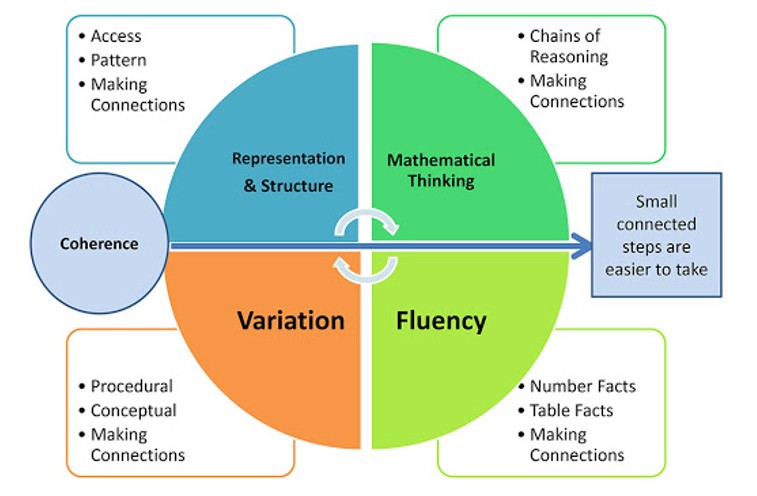
This model shows four key aspects of effective maths learning: representation & structure, mathematical thinking, fluency, and variation. Together, they help pupils build deep understanding by making connections, recognising patterns, and developing efficient problem-solving skills. By linking these elements, learning becomes more coherent, and complex ideas are broken down into smaller, connected steps that are easier to grasp.
Here are some simple definitions for each:
- Representation & Structure: Using diagrams, objects, or symbols to show maths clearly and help see patterns and how ideas are organised.
- Mathematical Thinking: The ability to explain, reason, and make connections between different maths ideas

- Fluency: Being confident and accurate with basic skills and facts, and able to use them quickly. Examples include a quick recall of number bonds, times tables and related facts.
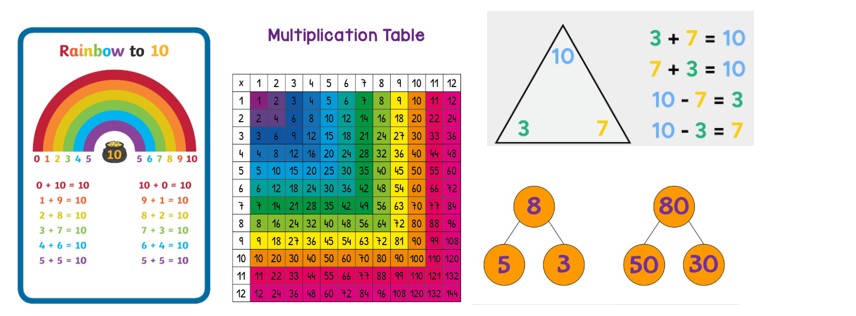
- Variation: Learning a concept by seeing it in different ways and examples, helping to deepen understanding.
Curriculum Implementation
Alongside developing children’s fluency in arithmetic skills, a key part of every lesson is for children to have opportunities to reason mathematically. At Northleaze, we provide opportunities for children to apply their skills and understanding to everyday, ‘real’ contexts where possible within lessons. Children are encouraged to enquire and explore their understanding through investigations and open-ended problems. We encourage our children to talk mathematically and they are always asked to explain their answer. This mastery approach to the National Curriculum for maths ensures the children spend a sufficient length of time on each unit so that they are secure in using and applying their new skills before moving on to tackle new concepts. Mastery of mathematics is not a fixed state but a continuum.
Key features of a Maths lesson at Northleaze
- A daily maths lesson of 45-60 minutes is taught in Years 1 to 6 and follows the small step structure of the White Rose Maths scheme, where understanding of key concepts is built on throughout a unit of learning.
- In EYFS pupils experience daily mathematics learning through whole class teacher input; teacher directed tasks and child-initiated play. Opportunities for mathematics is developed through daily routines and all areas of learning.
- Reception class do a shorter daily Mastering Number lesson. Wider mathematical concepts, such a space, shape and measure are introduced through the White Rose scheme.
- Year 1 and 2 have an additional four Mastering Number sessions per week on top of their daily maths lesson to build their number fluency.
- KS2 classes follow a Systematic Approach to learning times tables and these are practised daily.
- Children are encouraged to use the Numbots app (KS1) and Times Table Rock Stars (Year 2 – Year 6) outside of the maths lesson and can access it from home to embed their knowledge.
- Year 1- Year 6 embed Flashback 4 into the day so that prior learning is retrieved and revisited regularly.
- During lessons, teachers actively check for understanding, ensuring that any whole class misconceptions are addressed and they intervene quickly to prevent individuals being left behind.
- A lesson consists of the same content for all learners in line with the National Curriculum’s expectation that the ‘majority of pupils will move through the programmes of study at broadly the same pace’. This will be the case unless children are working significantly below age-related expectations.
- Open-ending questions are used to encourage children to explain and justify their thinking using precise mathematical language, modelled by adults and scaffolded through the use of sentence stems. Use of talk partners are used throughout the lesson to encourage children to their thinking and learn from peers.
- You will see children ‘taking risks’ and building on a shared understanding that making mistakes is part of the learning process.
- During the teacher’s input, children will regularly engage by practising and demonstrating their learning on ‘Show me’ mini-whiteboards.
- All children experience CPA (concrete, pictorial and abstract) when learning new concepts and consolidating knowledge and skills – see CPA section below for further explanation.
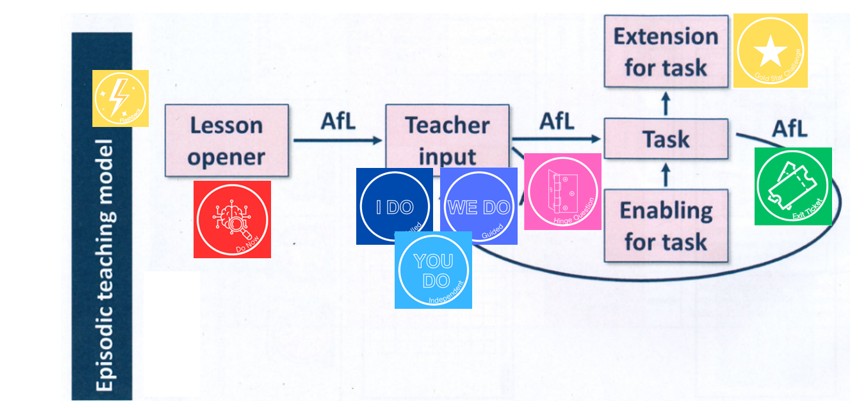
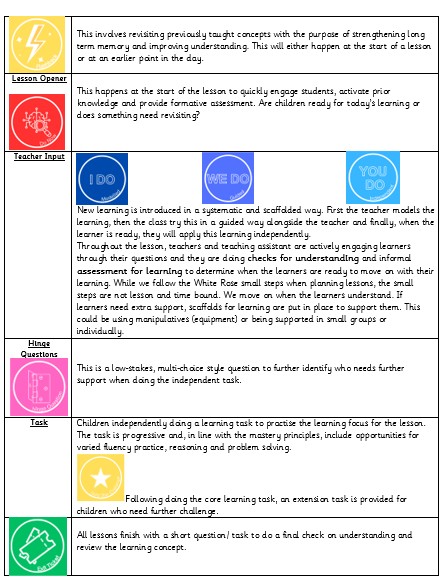
A typical lesson structure
Concrete, pictorial and abstract (CPA):
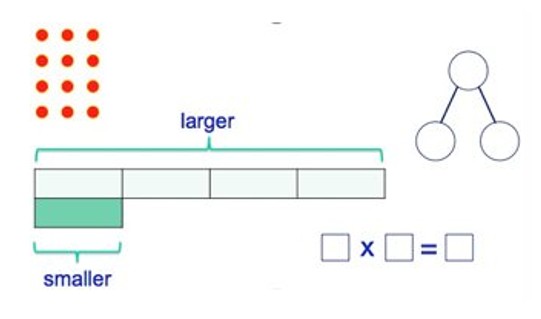
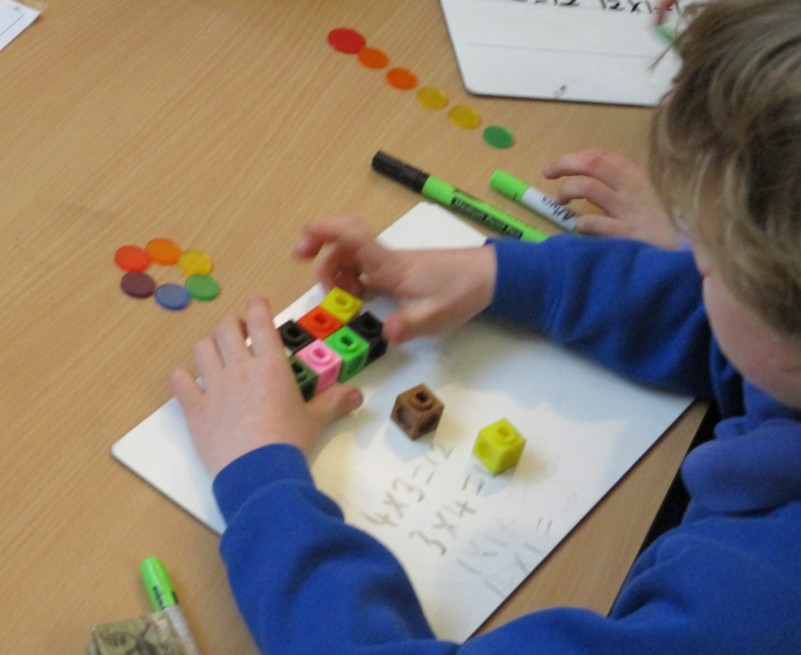
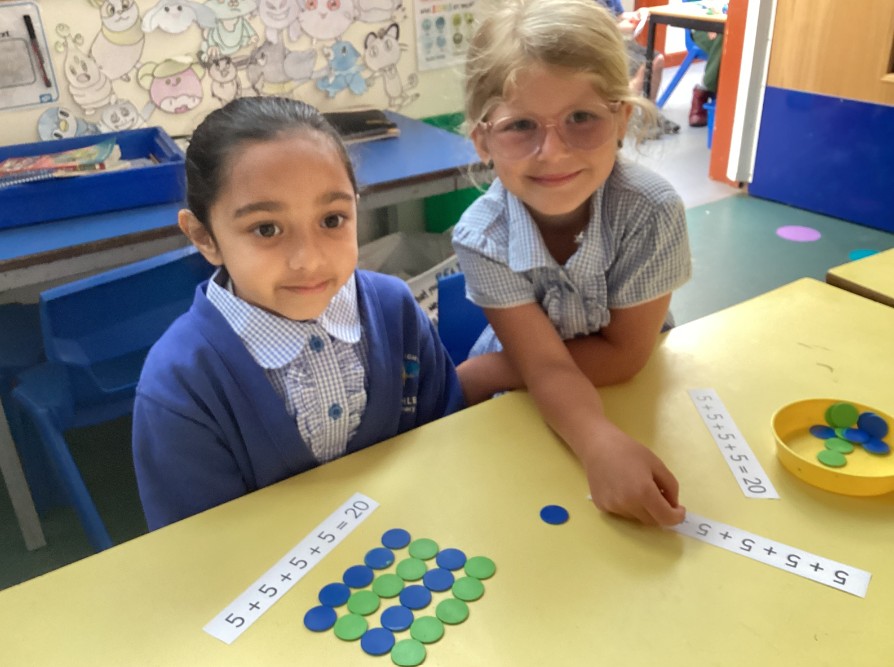
The learning of new concepts in maths is supported by the use of ‘concrete manipulatives’ such as tens frames, number beads, number lines, Numicon, Dienes and place value counters designed to enhance children’s visual and kinaesthetic understanding. As their conceptual understanding develops they move towards the pictorial representation of the learning (for example, bar model, number lines) and finally progress towards the abstract numeral and symbols. Children who require more support will remain at the concrete and pictorial stages for longer.
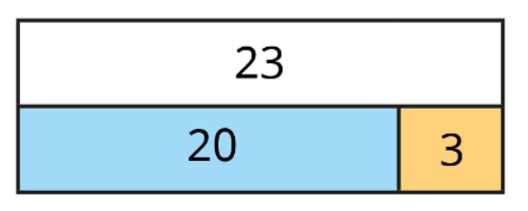
Here is what each stage could look like to represent 20+3=23
The Concrete:
Here, the physical counters and tens frame have been used to represent the calculation and the composition of 23.

The Pictorial:
Here, the pictorial bar model has been used to represent the calculation.
The Abstract:
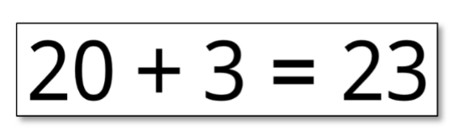
Here, is the number sentence written in numerals and mathematical symbols. Why is this abstract? Because all of the symbols within this number sentence have no intrinsic meaning or value, but rather our number system and our shared understanding gives them meaning.
Impact
Assessment takes place to ensure that the curriculum is meeting the needs of pupils. These assessments are used to inform teaching in a continuous cycle of planning, teaching and assessment.
Day-to-day assessments
Lesson preparation is a valued part of the teaching process. Teachers plan for the possible misconceptions that children may experience through a lesson. As part of the ongoing teaching and learning process, teachers assess children's understanding through a range of Assessment for Learning strategies. Daily annotations are based on observation, questioning, informal testing and the marking and evaluation of work. This will also enable appropriate written and verbal feedback to be given to children and will inform planning for the following day. Teachers use clipboards to make daily annotations, which inform their day to day teaching and learning.
Teachers make use of diagnostic questioning throughout all stages of pupils’ learning, to identify misconceptions. Open-ended questioning is central to teacher input, enabling misconceptions to be revealed and explored. Marking and feedback will also identify misconceptions which will either be challenged or inform next steps.
Summative assessments
In Terms 3 and Term 6, Year 2 to Year 6 children will sit NFER papers in arithmetic and reasoning to assess their understanding and knowledge of the maths curriculum. Gap analysis is carried out to identify which key areas to focus on. Year 1 children are assessed against their year group KPIs (Key Performance Indicators.)
Following each maths unit, children complete a short, low-stakes assessment. These inform teacher planning and organisation of intervention groups so that children can ‘catch up’ on curriculum areas they need extra support with.
Pupil Progress Meetings
The amount of progress made and percentages of those children on track to reach end of year targets is analysed and discussed at termly data meetings.
Intervention programmes
The school operates a flexible approach to intervention programmes. Teachers work with individuals or guided groups led by themselves and teaching assistants to tackle children’s misconceptions in maths. Pre-teaching, flexible ‘catch up’ sessions and adult-led small groups within subsequent lessons are used with those children who have not progressed within a lesson, with the aim of ensuring that children are making the maximum level of progress and gaps are closed.